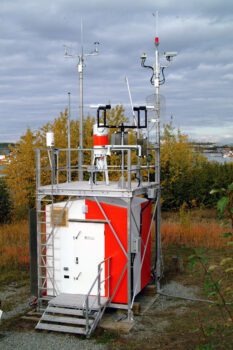
Automated Weather Sensor System
Over the years, AWI has developed a reputation for accuracy and reliability.
As a result, the company is the leading supplier of FAA
sponsored weather systems. The Automated Weather Sensor System (AWSS),
a follow-on to the FAA's
Federal AWOS program, is a surface weather observing system that provides
minute-by-minute weather observations. The AWSS features a flexible, modular
design that is capable of operating at different geographical locations with
a variety of advanced weather sensor configurations.
AWSS
State-of-the-Art Weather Sensors
The AWSS collects, processes, and ensures the quality of crucial weather
measurements. A wide range of precision sensor options is available:
- Forward Scatter Visibility Sensor:
an active, electro-optical instrument that determines visibility by measuring
the optical extinction coefficient of a beam of light as it passes through
a known volume of air; advanced four-head, dual beam design measures fog,
dust, rain, snow, haze, smoke, and sand.
- Ceilometer: a GaAs
laser diode emits a laser pulse that is partially reflected from the cloud;
the time when a pulse leaves the transmitter to when the reflected portion
reaches the receiver varies with cloud height.
- Present Weather Sensor: measures
precipitation by detecting the optical irregularities induced by particles
falling through a beam of partially coherent infrared light.
- Wind Speed Sensor:
a low-threshold, three-cup anemometer mounted to the top of the tower that
measures wind speed.
- Wind Direction Sensor: a highly
sensitive vane mounted to the top of the tower that measures wind direction.
- Freezing Rain Sensor: detects an occurrence of freezing rain by the change
in the probe tip's oscillating frequency caused by ice accretion.
- Tipping Bucket Rain Gauge:
precision sensor used to measure rainfall volume or rate.
- Motor Aspirated Radiation Shield with Temperature & Relative Humidity
Sensor: precision temperature/humidity sensor housed in a Motor Aspirated
Radiation Shield; designed for ventilation, and shielding from direct and
reflected solar radiation and from direct moisture contact.
AWSS Comprehensive Reporting
The AWSS issues weather reports using predefined formats and communications
protocols. Weather observation data can be made available to both local and
remote users.
The password-protected user interface accommodates a variety of users. Weather
observers may edit automatically generated weather data and daily and monthly
summary reports, and manually generate special weather reports (SPECIs). Air
traffic control specialists can perform limited editing functions and control
the manual recording of voice messages to be used with automated voice weather
report outputs. Technicians can change the system's configuration and execute
system diagnostics and tests. System managers may change and assign passwords
and the remote access code, and can access all technician user level functions.
AWSS Data Collection Units
The AWSS is a comprehensive system of meteorological sensors whose data is
gathered by a Field Data Collection Unit (FDCU). The data is checked for errors
then transmitted via a UHF or land line data link to a Terminal Data Acquisition
Unit (TDAU). At the TDAU, the data is processed, logged, and disseminated
by various means, including an ADAS connection to the internationally accessible
National Airspace Data Interchange Network (NADIN), dial-up telephone line,
CRT displays, and VHF ground-to-air radio transmitter.
The AWSS operational software collects, processes, and reports the weather
data. It also provides an interface for observers and technicians, and communicates
with the Field Data Collection Unit and the system's communications interface.
AWSS Installation and Maintenance
The AWSS is easy to install and inexpensive to maintain. Its modular design
allows you to mix and match exactly the functions you need. An easy-to-follow
AWOS site preparation checklist ensures error-free installation. The optional UHF data
link means expensing trenching and cable runs from the field station to the
displays are not required.
Built-in diagnostics continually check each sensor for accuracy and correct
operation. Should a failure occur, it is reported immediately. The diagnostic
software points the technician to the exact component that needs attention,
making mean time to repair the lowest of any advanced weather monitoring system.
AWSS Remote Maintenance Monitoring
All AWI AWSS systems have full Remote Maintenance Monitoring (RMM) capabilities.
This ensures that should a failure occur, AWI knows about it as soon as you
do. We then provide either a replacement part or an engineer to solve the
problem.
AWSS Experience
AWI is the FAA's supplier
of choice. The company has over 25 years experience providing advanced weather
systems to airports around the world. To ensure complete customer satisfaction,
all systems are built to the highest standards of quality and reliability,
using only the latest proven technologies.
|